

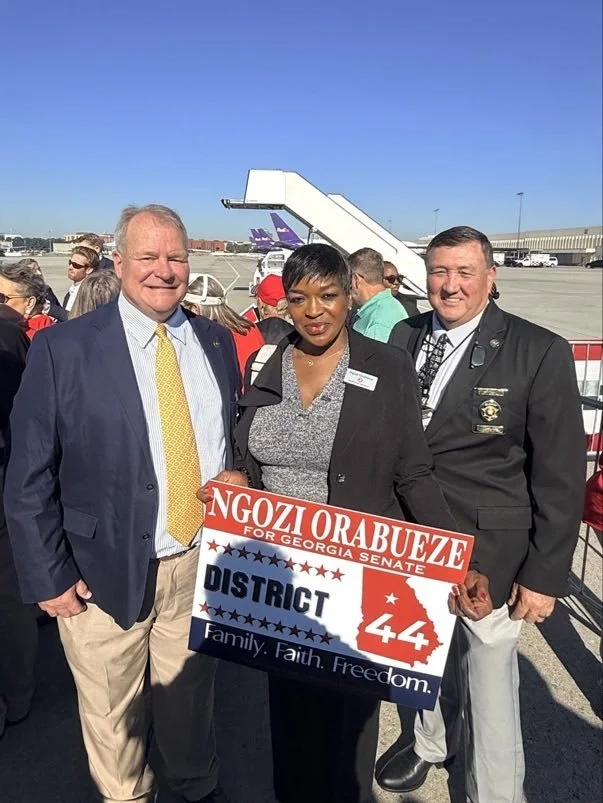
Dr. Ngozi Orabueze at a reception for the U.S Vice President JD Vance
In the November 3, 2026 U.S. midterm elections, a group of candidates of Biafran or broader Igbo heritage sought offices ranging from state legislatures to Congress, drawing attention from Biafrans worldwide and the Alliance of Biafran Americans, a political action committee.
The group highlighted these runs as a marker of diaspora participation in American democracy, with particular emphasis on Dr. Ngozi Orabueze’s Republican candidacy in Georgia State Senate District 44.
Orabueze, a family and psychiatric mental health nurse practitioner and CEO of Georgia Act and Healthcare Services, advanced unopposed from the Republican primary with 1,855 votes.
In the general election, she received approximately 7.5 percent of the vote (6,598 votes) against Democrat Saira Draper, who won with 92.5 percent (81,018 votes) in a deep-blue district where Democrats have frequently faced little or no opposition.
District 44 covers parts of DeKalb and Clayton counties, including areas around Decatur, Druid Hills, Jonesboro, and Morrow.
Orabueze’s campaign emphasized family and Christian values, freedom, elimination of home property taxes, healthcare access, public safety measures pairing mental health professionals with law enforcement, support for small businesses, and equitable school funding.
She received endorsements from Georgia Right to Life PAC and Veterans for America First.
Orabueze also serves as Deputy Prime Minister and Chief of Staff of the United States of Biafra (USB), a de facto government associated with Biafran independence advocacy.
USB leaders, including Orabueze, have cited longstanding grievances over marginalization, insecurity, and treatment of Christians in Nigeria’s southeast as reasons for seeking exit from the Nigerian federation.
The government distinguishes itself as governing all the Indigenous People of Biafra (IPOB) led by Nnamdi Kanu, with USB Prime Minister Simon Ekpa previously detained in Finland.
Orabueze’s ballot placement is framed as elevating diaspora visibility and linking local U.S. issues to concerns about religious freedom and security in the Biafra region, while also building Republican infrastructure in an uncontested seat.
The Alliance of Biafran Americans listed additional candidates of similar heritage running in 2026:
KC Ohaebosim (Democratic running mate for Kansas lieutenant governor),
Gabe Okoye (Democratic Georgia State House District 102),
Justin Onwenu (Democratic Michigan State Senate District 1),
John Olumba (Wayne County Executive candidate in Michigan),
Janelle Anyanonu (Democratic New Mexico U.S. House District 19),
Ndidiamaka “Didi” Okpareke (Republican New Mexico U.S. House District 1),
and Junior Ezeonu (Democratic Texas State House District 101).
Okpareke, a pharmacist whose parents emigrated after the 1967–1970 Nigerian Civil War, ran against an incumbent Democrat. Some of these candidates, including Ezeonu and Okoye, secured victories according to early reports.
These candidacies reflect a broader pattern of African diaspora political activity in the 2026 cycle, amid debates over immigration, redistricting, and representation.
For Biafran advocacy, formal participation in U.S. elections—particularly securing ballot access in competitive or previously uncontested races—serves as a practical demonstration of civic engagement and a platform for international visibility.
Orabueze herself described her run as proof that Biafran advocates operate within democratic systems rather than outside them.
Whether such efforts translate into sustained influence on U.S. policy toward Nigeria or greater local Republican competitiveness in urban Georgia districts remains a longer-term question as results are certified and new legislatures convene.